




Mining.com reports that Hudbay Minerals broke ground last week on its New Ingerbelle expansion at its Copper Mountain operation in British Columbia, extending mine life beyond 2040 and reinforcing its long-term commitment to one of Canada’s premier copper districts and Canada’s commitment to securing its position in the global critical minerals supply chain.
For most investors, the announcement was about another mine expansion.
For those watching the copper sector more closely, it signals something much larger.
The Juniors often focus on drill results.
The Majors focus on mineral districts, doability and longevity.
That’s why the decision by Canada’s top 3 copper company to expand its Copper Mountain operation in British Columbia matters.
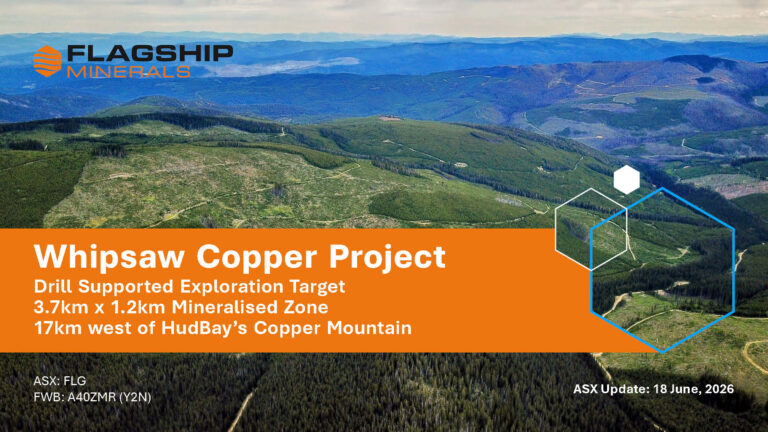
Located approximately 17km east of Flagship Minerals’ recently acquired Whipsaw Copper Project, Copper Mountain is one of Canada’s longest-running open pit copper mines. It currently operates a 45,000 tonne per day processing plant and, following the New Ingerbelle expansion, is expected to remain in production beyond 2040.
The expansion is expected to unlock an additional 750,000 tonnes of contained copper, 900,000 ounces of gold and 5.5 million ounces of silver.
That is not the type of investment a major miner makes without confidence in the future of the project, the district and Canada’s policy environent.
For Flagship and the Whipsaw decision, this was an important validation point.
Whipsaw sits within the same established copper belt, benefiting from proximity to existing roads, power, workforce, mining services and operating infrastructure. More importantly, it sits beside a district where a major producer continues to commit substantial capital to future production.
That matters because the big money wants certainty and, with the underlying thematic for copper increasingly becoming one of scarcity, that positions Flagship and Whipsaw very well.
Global copper grades are declining. New discoveries are becoming harder to find. Permitting timelines are getting longer. Yet demand continues to grow, driven by electrification, artificial intelligence, data centres, renewable energy and grid upgrades.
Against this backdrop, large-scale copper opportunities in Tier-1 jurisdictions are becoming increasingly difficult to secure.
And this another one of the reasons Flagship acquired Whipsaw.
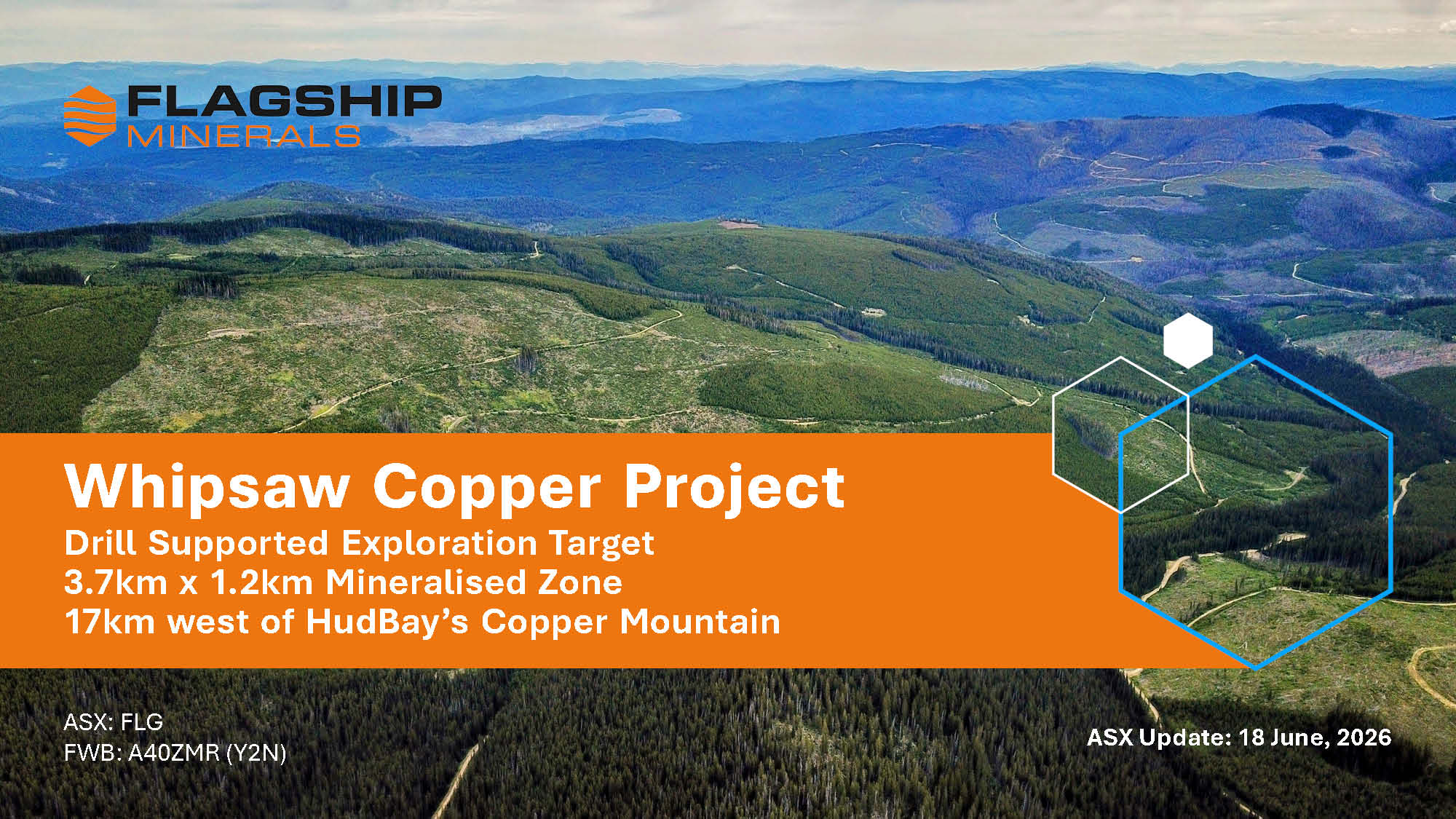
Historical drilling, geological mapping, soil geochemistry and geophysical surveys indicate the presence of a large-scale porphyry copper system extending approximately 3.7km in strike length and up to 1.2km in width.
And this is open along strike and at depth.
The Company has outlined a JORC (2012) Exploration Target ranging from 510Mt to 1,020Mt, highlighting the potential scale of the mineralised system, and at 0.2-0.4% CuEq the grades are in line with Copper Mountain and Teck’s Highland Valley to the north.
Importantly, Whipsaw is not an isolated exploration project in a remote frontier jurisdiction. It sits in a mature mining district where billions of dollars have already been invested and where major producers and their investors continue to deploy capital for the decades ahead.
The market often focuses on individual projects.
The Majors focus on districts.
Hudbay’s decision to extend Copper Mountain beyond 2040 sends a clear message: this district has a long future ahead of it.
For Flagship that was one of the powerful ‘buy’ signals for Whipsaw.