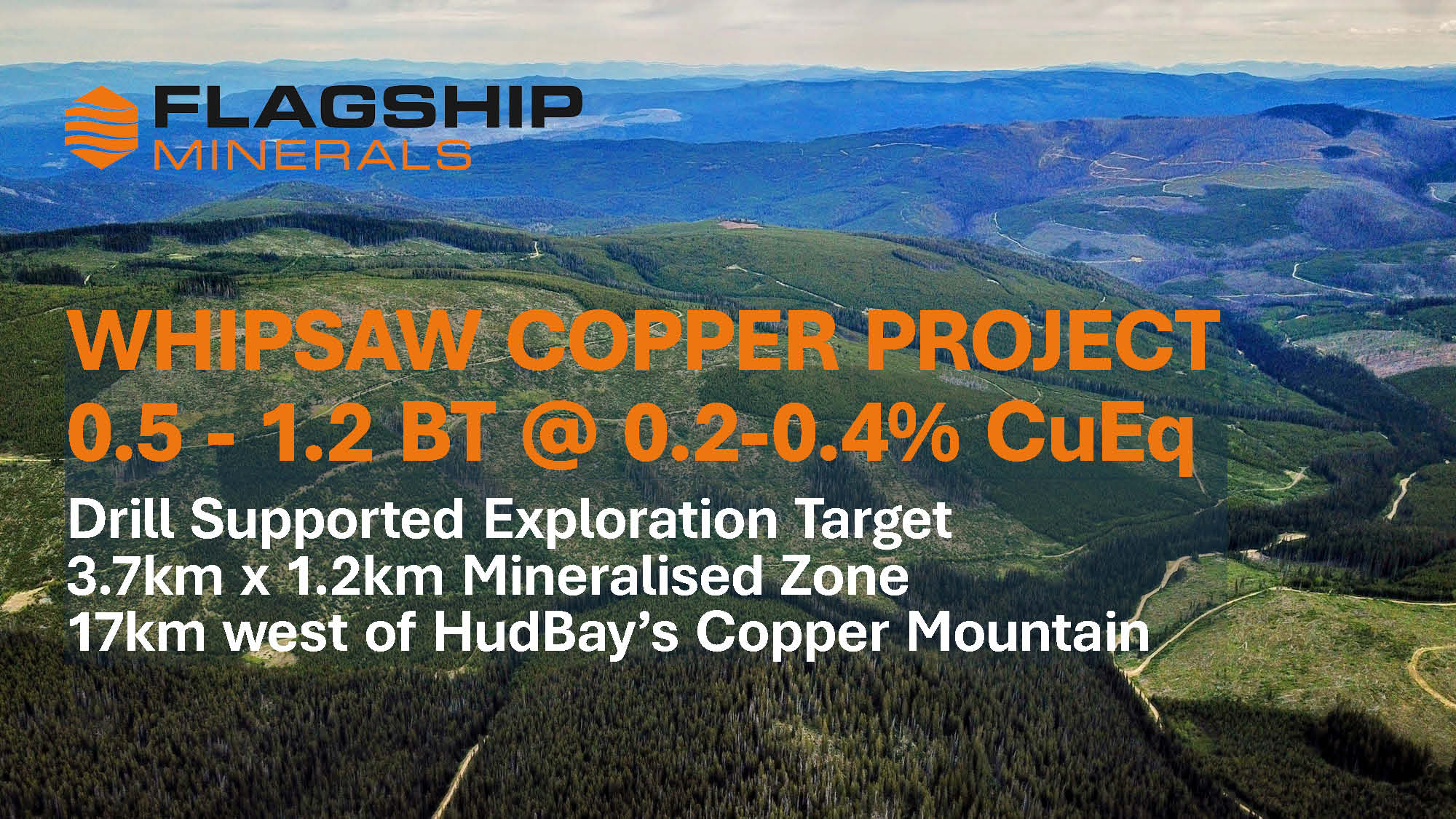
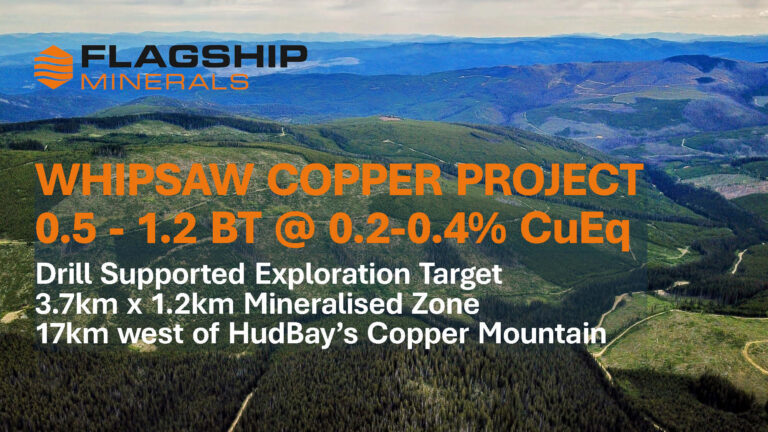
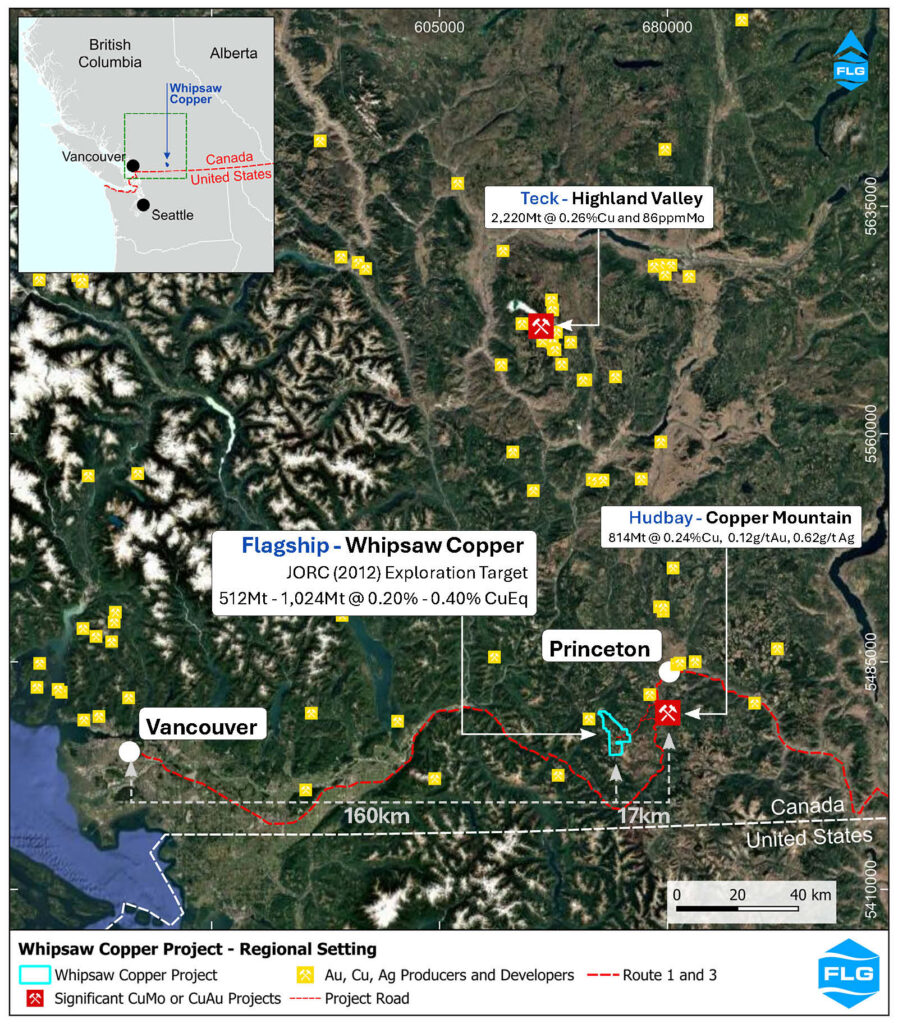
Whipsaw is a large-scale porphyry copper project located ~17km west of Hudbay’s Copper Mountain and ~160km east of Vancouver.
The project has a substantial JORC (2012) Exploration Target of 0.51 – 1.02 Billion tonnes @ 0.2-0.4 CuEq across a mineralised system extending approximately 3.7km in strike length and up to 1.2km in width.
The Whipsaw Copper Project is a large-scale porphyry copper project located ~17km west of Hudbay Minerals’ Copper Mountain Mine and approximately 160km east of Vancouver, within one of Canada’s most established and infrastructure-accessible mining regions. Copper Mountain is a long-operating, district-scale open pit copper mine.
Whipsaw Copper Project – Regional Setting
Historical drilling, geological mapping, soil geochemistry and geophysical surveys support a substantial JORC (2012) Exploration Target of 0.51 – 1.02 Billion tonnes @ 0.2-0.4 CuEq across a mineralised system extending approximately 3.7km in strike length and up to 1.2km in width.
Flagship acquired Whipsaw in June 2026 as part of its strategy to build exposure to the long-term copper thematic while complementing the Company’s flagship 2.1Moz Isidora Gold Project in Chile.
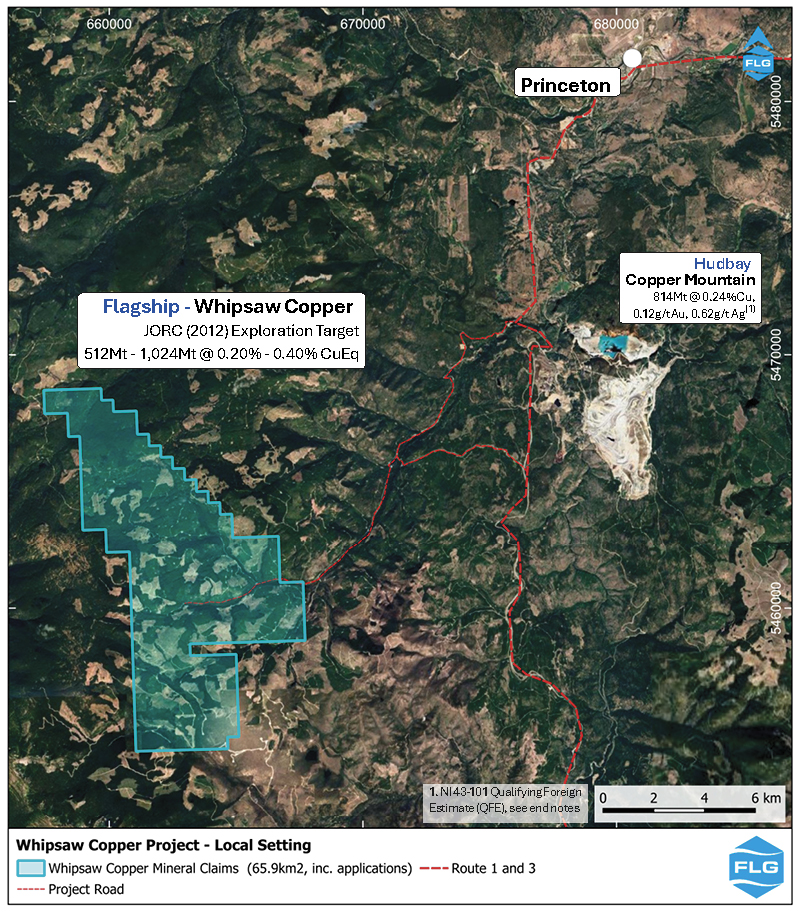
Whipsaw Copper Project – Local Setting
The Whipsaw project straddles an 8 km segment of the regionally mineralised contact zone between the Upper Triassic Nicola Group and the Jurassic–Cretaceous Eagle Granodiorite Batholith. The central feature is the Whipsaw Porphyry, a multiphase feldspar–hornblende porphyry stock emplaced along this contact. The porphyry intrudes Nicola volcaniclastics and schists, with dykes and sills extending north and south parallel to the contact.
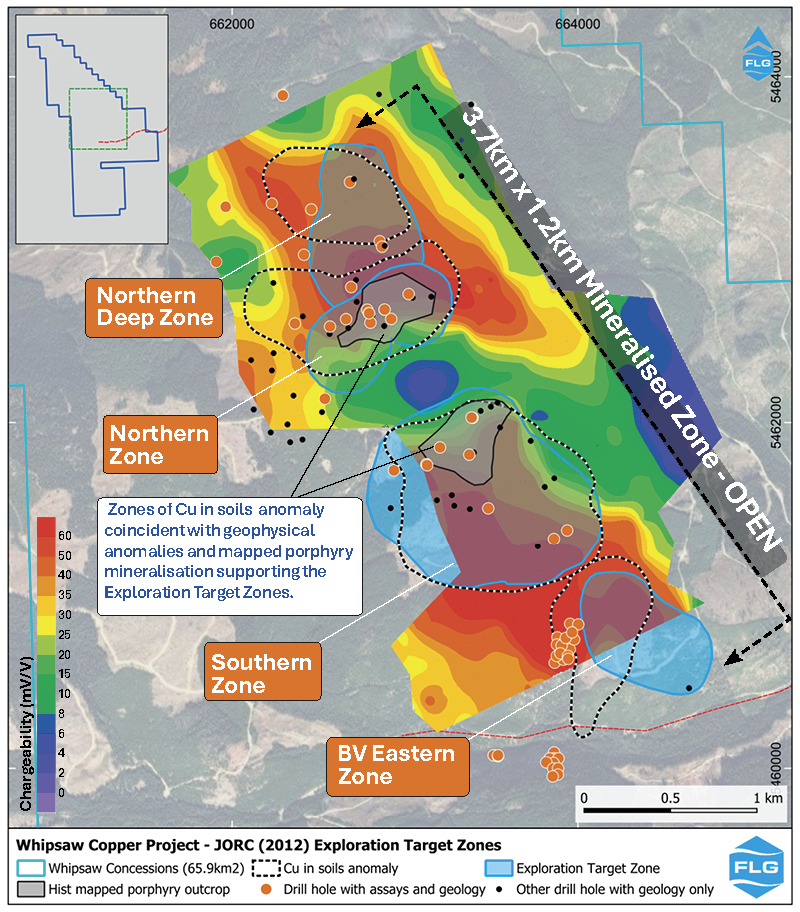
Plan view showing extent of the four Exploration Target Zones.
The Nicola Group comprises schistose andesitic volcanics, argillites, and minor limestones, typically strongly foliated at 150–160°/moderate–steep west dips. Localised skarn horizons occur near carbonate-bearing Nicola units, hosting epidote–magnetite and epidote–grossular assemblages with associated Cu–Mo or Zn–Pb–Ag-Au mineralisation.
The Whipsaw Porphyry displays intrusive breccias containing fragments of Nicola, Eagle granodiorite, and altered porphyry in a shattered porphyritic matrix.
Disseminated and veinlet‑hosted chalcopyrite, pyrite, and molybdenite occur within and adjacent to the Whipsaw Porphyry but are strongest in the surrounding Nicola volcaniclastics. Mineralisation is associated with B‑type quartz veinlets, stockworks, and fine biotite alteration.
The Exploration Target for the Whipsaw Project has been developed from a geological model constructed in Leapfrog (2025.3) using drilling, surface geochemistry, geophysical datasets and mapped geology.
Mineralisation at Whipsaw is interpreted to represent a large, low‑grade Cu–Mo–Au–Ag porphyry system associated with porphyritic dykes intruding Nicola Group sediments.
Four mineralised domains were modelled using implicit intrusion modelling workflows and constrained by lithological boundaries, CuEq grade continuity, geophysical responses and anomalous surface soil extents.
JORC (2012) Exploration Target and CuEq Grade Ranges
See Flagship’s ASX Release dated 18 June, 2026 and titled “Whipsaw Acquisition – Large Scale Copper Project, Canada”
The potential quantity and grade of the Exploration Targets are conceptual in nature and, as such, there has been insufficient exploration drilling conducted to estimate a Mineral Resource. At this stage it is uncertain if further exploration drilling will result in the estimation of a Mineral Resource. The Exploration Target has been prepared in accordance with the JORC Code (2012).